Showing posts with label Black Power. Show all posts

Sunday, 5 June 2022

Minden 1759 - in 6mm using Blackpower


The battle of Minden on the 1st August 1759 was a major battle between an Anglo-German army and the French towards the end of the Seven Years' War. Many years ago, I lived near Minden in Germany and this battle has therefore always been one in which I have been interested. For further details please see:


I'd casually suggested to my gaming friends that I'd like to refight Minden and found myself on the hook to arrange the battle, something I was very happy to do.  The next month was busy creating the order of battle, deciding on the attributes of the units and painting an extra sixteen battalions and three cavalry regiments. One of the joys of 6mm is I can paint and base a battalion of 24 figures in about an hour.

The Battlefield


The forces

I was keen to try and reflect the historical advantages and disadvantages of the forces engaged in the battle, especially the performance (or lack of performance) of Sackville commander of the British contingent at the battle.  I'd always written him off a poor commanded but having read more about his courts martial in Like a Brazen wall by Ewan Carmichael I now wonder if he was thrown under the proverbial bus for political reasons. 
It was important to give the British troops stats that gave them a chance to perform as well as they did at the battle.  I was also aware that French battalions at the battle were in general smaller than those of the Anglo-Germans.
As the battle was going to be fought on a 6'x4' table in a morning, I reduced the number of units represented to One Battalion per two battalions actually present and each of my cavalry regiments represented about five squadrons. 

The re-fight of the Battle

I was joined by three of my friends, Mark Browne, John Dance and Paul Smith.  Mark and I took the French-Saxon and John and Paul the Anglo-German.  Each of the commanders were labelled with their name, command rating and the break point of their command.

Pre-Dawn at the Anglo-German HQ

View of the Battlefield from Kutenhausen towards the French lines with Malbergen in the mid-ground.

French Right Wing

The assault by the French right wing played out historically correct.  The French Grenadiers bravely lead the assault on the Anglo-German left under Von Wangenheim.  Although brave the French forces could not withstand the bombardment by the allied artillery backed up by their Converged Grenadier Brigade and Hanoverian forces.  The French grenadiers under Comte de Saint-Germain's broke leaving the remaining French forces out numbered by the allies behind their field entrenchments. 

French assault reduced to by half after the loss of the Grenadiers de France & Grenadiers Royaux.

French Centre

The French centre pushed forward and took the village at Malbergen.  It was a good defensive position and they held off the frontal assault by the Anglo-German centre but the collapse of the French right wing left the right flank open and the command had to be given to withdraw back towards Minden.

French centre holding steady 


Flanked


The French Left

The role of the French left was to quickly smash the Anglo-German forces between Hahlen and the woods and then to turn the flank and then join the forced at Malbergen in the centre of the battlefield. Wave after wave of  French horse changed the allied forces, supported by French foot.  Unfortunately the British heavy cavalry were able to activate and advanced into the fight.   In the end the French won but had to throw in their Saxon reserve under Prince General Xavier.  

French push north from Hahlen the British just the other side of the woods


The French reserve (Saxon's under Prince General Xavier


The End

Despite a victory for the French on their left but to little and too late.  The French right was lost and the centre could not hold without support.  Maréchal de Contades was forced to concede defeat.  The battle fought out pretty much the way it did in history. The French righ were wiped out by Anglo-German artillery and the huge French cavalry force were wiped out, although in this version by Hanoverian Infantry and the British horse. 

Aftermath

It was wonderful to be able to play a game with friends after such as long lockdown.  I'd like to give a huge thanks to my friends, John, Mark & Paul, for indulging me  I bit off a little more than I could chew with this battle as I'd hoped we could run it in 2-3 hours and it took 4. Sadly several players had to leave and missed the last hour. I have some ideas on how to make our next battle quicker....  


Sunday, 20 June 2021


1757-04-21 - Combat of Reichenberg


In the Spring of 1757, during the general advance of the Prussian columns on Prague, the Prussian Lieutenant-General August Wilhelm Duke of Braunschweig-Wolfenbüttel-Bevern’s column encountered an Austrian force under Feldzeugmeister (FZM ) Count Christian Moritz Mauritius Eusebius, Königsegg-Rothenfels.

Bevern's column came upon Königsegg who was manoeuvring ahead in superior force (26,000 men). Königsegg who could field some 16,000 men. Bevern approached Reichenberg in the evening of April 20 and found his way barred and had to take camp.

 see http://www.kronoskaf.com/syw/index.php?title=1757-04-21_-_Combat_of_Reichenberg

This was my first post lockdown game with my friends Mark and John.  John is a natural defender then counter attacker.  Mark is less experienced and therefore generally likes to be part of a team.  So just to surprise me Mark opted to be the sole Austrian defender and John and I were to Prussian attackers.  This was the first of joys of playing with real people and not solo.

As the Prussians were planning on joining the Army of Silesia. I had assumed this battle was in Poland but it was actually in central Germany.


This was a defensive battle with entrenched Austrians along a hill line and in wood, with attacking Prussians. In the actual battle the Prussians won.
The Austrian lines


The battle started with the Prussian right wing. lead by the one cavalry brigade,  moving to and crossing the marshes. The Austrian cavalry brigades came forward to meet them.  


The battle on the Prussian right wing went well for the Prussians and the Normann Dragoon brigade was destroyed by Prussian musketry and broke fleeing the battlefield.    The remaining Katte Curassier brigade bounced off the elite Prussian Grenadier battalions.   The Prussians were poised to advance into the woods and assault the Austrian  in their woodland defences.

Meanwhile in the Prussian centre and left the brigades advanced into the cannon fire from the entrenched Austrians.  The stream down the centre of the valley did not have much impact on the advance.


As my Prussian assault advanced on the Austrian lines, I was surprised by Mark as his troops abandoned their defensive fortifications to try and flank my assault.  This resulted in a battle line running across the battlefield as my troops had to turn to face the threat.  Luckily my read was secure as John's forces on the Prussian right flank had broken the Prussian cavalry threat and the Austrian troops in the woods were trapped in their own fortifications.


It was a bit touch and go for a moment with one of the assaulting Prussian brigades breaking under the Austrian counter attack but the Prussians had the numbers and Prussian Dragoons coming up from the right flank swung the day and the Austrians were forced to concede the battlefield due to the lose of too many brigades.


An enjoyable game with tactics I'd never have used if i fought it solo. 


Saturday, 19 June 2021


Black Power Rules 
and the Seven years' War, War of Austrian Succession and the War of Spanish Succession


 I thought I'd post on here my customisations for Black Power v2 for fighting SYW, WAS and WSS.


Below are my thoughts on troop types for the major armies and their stats.  The stats include  points costs, although most of my battles are based on historical orders of battle.

Not that it makes any difference to the rules but I play in 6mm and convert all BP measurements to cm.

I must add that these are very much work in progress and intended for wargames between myself and friends.  Please free to use them as much as you like for your games.  They may not be sold or used for profit.  If you use them, let me know. If you have improvements, let me know.

Have fun!

Eddie Stewart game@whitetiger.me.uk 

Saturday, 23 January 2021

WSS Counter Ambush


This was my first lockdown battle of 2021. I based the battle on the count-ambush scenario from Programmed Wargames Scenarios by Charles S Grant. I tried a new approach which was sharing notes and pictures with my friends on messenger. (Which is the reason for some poor spelling on the picture labels.)  The battle was fought in 6mm using Blackpower 2 rules with  rule supplements and my troop statistics.

English Foot


Bavarian Foot


The year is 1704, the War of Spanish Succession is in full swing. While the Duke of Marlborough is manoeuvring his army into what will become the battle of Blenheim he becomes aware of a French supply train carrying vital gunpowder stocks protected by a small escort  of Dragoons. A joint English/Imperial force is positioned for an ambush on the north/south road.

Map of the Battlefield
 (Top of the map is North East. East to West is [C] to 8.)

Two English Brigades (6Bn) are placed in the woods (location 2) with two Gun batteries on the hill to their south (loc 8).  This will allow the English forces to attack the North-South road from the West and for the Guns to sweep the road as far as the bridge.  A brigade of English Dragoons hides in the woods (loc 3) ready to cut off the French.

The Imperial forces with their overall CinC have a strong brigade (4 Btn) in the woods (loc 1) and two batteries of guns. The marshy ground (loc 4) is occupied by two btn of Pandours. (Panadours are irregular light infantry from the Hungarian boarder with the Turkish empire.  First class looters, 2nd class soldiers but perfect for fighting in rough terrain.)  The CinC has placed himself at this point  as the Imperial  brigadier is lacking in initiative.

English Brigade at location 2

Imperial Foot location 1

 Pandours making use of the marshes for cover


English Guns location 8

Alas….
Bourbon sympathises (presumably biscuit lovers) warned the French and the French General ordered a joint French/Bavarian force to march through the night into a flanking position to ambush the ambush.  Marching through the night resulted in some problems position the army and the entire Bavarian force became lost are a move off the battle field to the north.

Two regiments of French Light cavalry (Loc [A]), despite the title they are heavy cavalry the name was used to remove confusion with the Kings Household cavalry with orders to sweep down to the woods at loc 3. Three battalions of French foot with attacked Aty [loc B] with orders to assault the woods at 1. Four composite battalions for grenadiers (elite) (loc [C]  with orders to support the foot. Two dragoon regiments at loc [D] with orders to scout the woods at 6,5 and 1.
The “lost” Bavarians include, 2 Regts of kuirassiers with orders to move with the French Hse.  Three Btn of foot with attached Aty, with orders to support the attack on the woods at 1.
The Imperial /English forces find themselves out of position. Set up to attack an enemy on the north/south road but flanked by a force of roughly equal size!  

French Foot and the Generals Mistress arrive

Battlefield at Dawn

1st Hour after Dawn
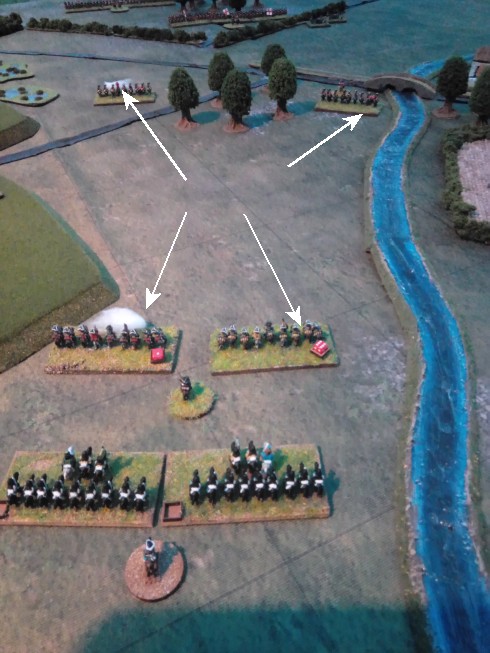
The Imperial commander realising that his position was exposed ordered his brigade to fall back to the English position.  At the same time the Pandours left the marshland and advanced to the woods knowing that fighting in rough ground was their forte.  The English command was in some confusion with one brigade wanting to advance and one wanting to hold.  The English Dragoons exited the woods to face the French horse.
The French Dragoons held position looking for Ambushes (failed order).  The French foot advanced to the woods (loc 1).  The French cavalry stood and watched the English Dragoons come out of the woods in from of them.


2nd Hour after Dawn
The Imperials made a fast march to the rear bringing them wall away from the woods. The Pandours closed in on the woods. The English straightened their lines.  The Dragoons choosing not to charge the French Cavalry.
The French Dragoons search the woods for further ambushes.  The French Foot in a show of French elan marched swiftly forward almost reaching the woods.  The French horse charge the English dragoons who counter-charged keeping in a close knee to knee formation. The two cavalry brigades clashed with brutal ferocity.  The English were slightly outclassed on paper but fully held their own in the melee. Both fights were bloody draws with all four regiments being shaken by the amount of casualties on each side and each brigade reeling back broken and of no further use in the battle.


The French horse charge the English dragoons who counter-charged keeping in a close knee to knee formation. The two cavalry brigades clashed with brutal ferocity.  The English were slightly outclassed on paper but fully held their own in the melee. Both fights were bloody draws with all four regiments being shaken by the amount of casualties on each side and each brigade reeling back broken and of no further use in the battle.


3rd Hour after Dawn
On the English (west) side of the field the English foot were disjointedly trying to form a battle line at the woods (loc 3).  The Panadours realising how close the French Infantry were to the woods fell back to the marshes,  The main Imperial foot continued to fall back. The Imperial artillery batteries dropped a fuselage of balls on the limbered French artillery, leaving them shaken.  
The French Foot held behind the woods waiting for the grenadiers and Bavarians to move up in support.  The civilian transport contractors deserted the guns leaving the gun crews to set up the guns.
The Dragoons galloped up behind the Imperial foot within musket range  in an overzealous interpretation of orders.
The "lost" Bavarian forces arrived behind the French lines.  A Kuirassier brigade of two regiments and a brigade of three battalions of foot.


4th Hour after Dawn
The rear two battalions of Imperial infantry took an initiative order to turn around and fire a volley at the French Dragoons who took minor casualties and fell back out of range.  Two English Btn in a moment of confusion decided to march sideways into a marsh. The Bavarian kuirassiers  opted not to charge the two English battalions to their front. Everyone else moved about a little bit but not significantly.

5th Hour after Dawn
The French Dragoons moved in to the woods (Loc 1), dismounted and took up firing positions.  The French grenadiers marched quickly towards the flank of the English battalions who were claiming out of the marsh.  The Bavarians  moved up on support of the Grenadiers but were left behind by their rapid advance.


6th hour after Dawn
The English fall back and form a line just out of musket range of the French Grenadiers.


7th hour after Dawn
In a reversal of the original French plan the Bavarian brigade advance rapidly through the French line and assault the English line.   Two battalions v two battalions.  One Bavarian battalion is destroyed and the other is shaken by casualties.  The loss of two battalions break the brigade.  The English battalions fall back but rally.


8th hour after Dawn
The Imperial brigade  after some confusion advance into contact with the French line brigade wile the French Dragoons exchange fire with the skirmishing Panadours.  The French line break under the assault and the brigade routs.  
The French Grenadiers realise that with the loss of the French line brigade and the Bavarian brigade it all depends on them and they fix bayonets and charge the English line. The fight is fierce but once again the French are out fought, and they reel back broken.


The French counter-ambush has failed.  The Imperial and English forces win the field of battle.


Victorious 


It was a fun game.  I'm not sure the idea of sharing the battle on-line with friends worked. It was a lot of rushed effort for little return.  The programmed scenario gave a good start point and overall strategy.

Sunday, 20 September 2020

Solo  Ottoman Empire vs Austrians - early 18th Century


This was a solo  fictional battle set around the time of the Austro-Turkish War (1716-1718). This puts it after the War of Spanish Succession (1701-14) and before the War of Austrian Succession (1740-48).

One of the challenges of a solo game is surprising yourself.  I have tried various systems which generally boil down to rolling a die to choose a flank to attack etc.  In one of Facebook wargaming sites I saw a reference to a book "Programmed Wargame Scenarios" by Charles S Grant, published by Caliver books, so I ordered a copy.

I have just finished paining an C18 Ottoman Turk army and was keen to try them out.  I chose scenario 1 - Hill line defence and put the Ottoman's in to defend.  I have read that the Ottoman's were bold strategically but very defensive tactically so having them defend seemed in keeping with this tactic.

I chose to play the the Austrian attackers and to let the scenario run the Turks.  I set up the Austrians is a conventional style, two cavalry wings with two lines of infantry in the centre.  Their goal was to capture the hills at the far end of the battlefield.

The battlefield as the Austrians saw it.
Centre

The battlefield as the Austrians saw it.
left


Returning to the scenario I then saw that the defender's map was a little different and there was a farmhouse and a long defensive wall right in the middle of the Turkish position.  This was a nice twist and greatly added to the fun of the battle.

My plan was for the cavalry to drive off the Turkish cavalry and for two brigades to loop around the right flank and assault the flank of the farm and for two brigades, including a Grenadier brigade) to pause and then assault the  farm front while the flank was engaged.  The plan was for the grenadiers to lead the final assault.

The Turkish deployment was controlled by the scenario, 50% in the centrem a strong right wing (35%) and a weak left (15%).  The Janissaries held the farm and wall in the centre, the Arnaut (Balkan) infantry and skirmishers were poised to take the village and Sapahi (armoured cavalry) with Akinci (raiding light cavalry) were on each flank with a central reserve of elite Kapu Kulu Sipahi.
The Janissaries and artillery deploy in the farm


The view of the farm from the Austrian Centre


My reading on on the Ottoman Turks lead me to believe that they had poor command control and except for the Janissaries the bulk of their army was irregular conscripts and volunteers.  They tended to lose battles unless they had a significant advantage in numbers.  (In my next blog I'll throw a few doubts into this.).  I therefore gave stats to the ottomans so that the janissaries were worse in a firefight than the Austrian infantry but better in melee.    I have read that in the SYW, Austria Grenadiers and Hugarian troops were armed with sabres and copied Janissary tactics - the forth rank would draw their sabres and wrap around the flanks of Prussian infantry during a melee. The Sapahi (armoured cavalry) were like feudal knights. individually good horsemen and brave but they didn't have the months/years of practice in charging knee to knee had be the regular Austrian cavalry.   I made them good cavalry but without the charge bonuses of regular cavalry.

The BlackPower rules  stats I assigned to the armies are here.

The cavalry engaged on the flanks and although the Austrian cavalry won most of the fights neither flank ended in a conclusive victory.  The battle would be decided in the centre.

The frontal assault on the Ottoman Farm was crushed. Only one Grenadier battalion managed to charge into contact the rest were stopped and then broke.  However the flanking attack was more successful.  The Austrian troops engaged in a long firefight. The Austrian musketeers were better drilled but the Janissaries had cover.  One Austrian brigade broke from casualties but the 2nd brigade took over the firefight and the Ottomans took so many casualties that they then broke.  The farm was taken although the Austrian lost 3 out of 4 infantry brigades doing it.  Only the fact that they still had 3 out of 4 cavalry brigades kept the whole Austrian army from breaking.

The assault on the farm just before both brigades attacking the front broke. 

The Austrian flank firefight observed by the CinC and his mistress (in the red coach).


Alas it was all, too little-too late, for the Austrians and although they had taken the farm and could have probably won any subsequent battle for the hills, they had run out of time.  The battle was a victory for the Ottomans as they had held the hill line until nightfall. (Under 18th century rules the Austrians claimed it as a victory, as they held more of the battlefield at the end of the battle than at the start.)

References:
  • Osprey Men-at-Arms Armies of the Ottoman Turks 1300-1774
  • Osprey Men-at-Arms Armies of the Ottoman Empire 1775-1820
  • Century of the Soldier - Peter the Great Humbled - The Russo-Ottoman War 1711
  • Caliver books - Programmed Wargame Scenarios