References:
- The very enjoyable Obscure battles blog http://obscurebattles.blogspot.com/2014/11/kolin-1757.html
- The outstandingly good Kronoskaf reference site http://www.kronoskaf.com/syw/index.php?title=1757-06-18_-_Battle_of_Kolin
Blucher rules.
The Blucher rules Blücher – Honour – Sam MustafaPublishing LLC are intended for Napoleonic campaigns and battles but with adjustment
seem to be fine for the Seven Years War (SYW).
As a rule set they are very easy to learn and allow you to fight major
battles such as Kolin with ~90,000 troops.
The rules use a random number of command points, rolled by your
opponent, so a general is never sure how much of his force he can move and is
therefore required to focus on the most important units first. Units (Brigades) have a combat rating (Elan)
which is worn down in combat. In these
rules your Elite brigade will start as more effective than a regular line
brigade but after a combat or two they will have fallen well below the fighting
effectiveness of a, average or even poor quality fresh brigade.
Rule changes
Cavalry in the SYW were not the force they
were in the Napoleonic period. This was
due to a combination different cavalry tactics and better drilled infantry. Infantry in the SYW & WAS did form square,
just not very often and usually when guarding a flank.
I do
not apply the rule that unprepared infantry when in combat against cavalry,
must re-roll its successes for its combat score. I keep
the rule that attacking cavalry Re-Rolls Dice against prepared infantry must be
re-rolled.
Players
I played this game in July with my good
friend John Dance and it was wonderful to have a face to face game after such a
long break. John commanded the Austrians and I the Prussian underdogs.
Battlefield
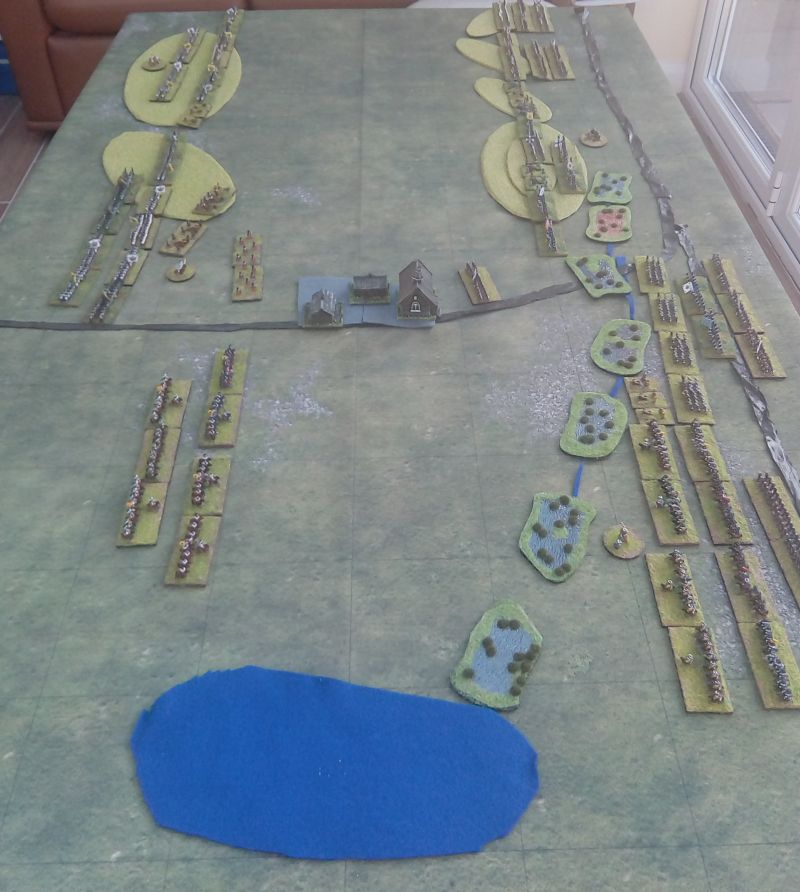
I set up the battle on my 6’x4’ table and
attempted to put in a few of the key terrain features, mainly the village of Kreczor/Kutlire and the
Swedish works as well as the central Przerovsky hill.

Battle
The Prussian plan was to refuse their right
flank and push the left flank through the Austrian right. The Austrian plan wasn’t to wait for the
Prussians but to advance their centre and left flank and roll up the Prussian
right.

The Blucher rules meant at the Austrians were not sure what types of troops their were facing on the Prussian right.


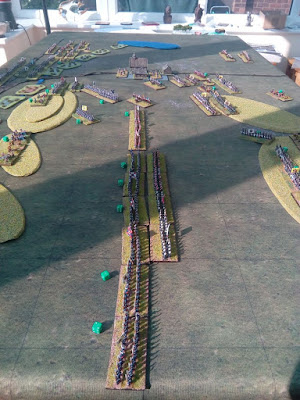
Unfortunately the Prussians found the ground leading up to Kreczor/Kutlire slow going and the advance was very slow. The Prussian left wing cavalry had a hard fight with their Austrian counterparts. Although the Prussians won, they were a spent force.

The Austrian assault on the Prussian right
wing was much more successful and began to drive the Austrian right wing into
the Prussian centre.

An historically correct result with the Austrians
defeating the might of the Prussian army.