Showing posts with label WSS. Show all posts

Thursday, 30 January 2025

Ramillies 1706 - Re-fight

 War of the Spanish Succession 23 May 1706

Pro-Habsburg Forces under The Duke of Marlborough approx. 69,000 with 120 guns
Pro-Bourbon Forces under le Duc de Villeroi & the Elector of Bavaria, approx. 68,000 with 70 guns

Played with Twilight of the Sun King rules (with one 60x30mm base per brigade rather than the standard two 60x30mm bases per brigade)  with 1200+ 6mm figures on a 6'x4' table.

Reference 

Battlefield
From the French point of view the left wing of the battlefield was separated by rough terrain not suited for cavalry.  The centre around Ramillies was more open and the right flank was ideal for cavalry. Both commanders placed their infantry on the French left and centre and massed their cavalry on the French right flank.  Both commanders  left some cavalry to guard the left flank but with no intention of actually attacking across the rough ground but rather just in case the opposition were foolish enough to do try an attack across the rough ground.

The battle commenced with an artillery bombardment.  One of the things I like about the TotSK rules is that long range artillery bombardments may disrupt troops maneuvering but unless massively concentrated they will not cause casualties (a loss of moral in these rules.)


The  infantry of the  Grand Alliance ( Austria, England, and the Dutch Republic) under Marlborough  advanced on the French, slowed down by the rough ground separating the armies on the left of the French lines.  The British horse pulled away from their position on the French left and rode with some hast behind the British lines heading to the other flank. 


The French cavalry advanced smartly against the  Grand Alliance cavalry.  The Duke of Villeroi plan being for his superior cavalry to crush their opposition and then to flank the allies infantry lines. 

The cavalry wings clashed, over 150 squadrons of cavalry, 20,000+ cavalry charging and counter charging.  A nice detail in the TotSK rules is that defeated cavalry flee a full move from a losing combat unless they have reinforcement to their rear in which case they fall back behind their support.  This givens a nice rolling combat with weakened horse falling back behind reinforcements.


In the centre the allied infantry assaulted Ramillies and then Offus and finally Autra-Eglise.    Unlike the cavalry fight the infantry combat was a slower grind.  The rules give a bonus to moral tests for troops with rear support  and infantry  inherently harder to break than cavalry (3 hits opposed to 2).


The cavalry fight was going against the French when  the arrival of the British horse pulled from the opposite flank made it even more difficult for the French and lead to the eventual collapse of the French cavalry wing.


The Allied cavalry started to wrap around the flank of the French army.  The French infantry still held the three villages of Ramillies, Offus and Autra-Eglise although the fight was starting to slowly swing in favour of the allies. However with the allied horse free to swing onto the flanks and rear of the French Army,  the Duke of Villeroi conceded the field  and victory to the  Grand Alliance.


Comments
This wargame ran very close to the original battle.  I found the Twilight of the Sun King rules to be quick and to give a "realistic"  outcome.


Thursday, 26 December 2024

Ramillies 1706 - Setup


Ramillies 1706

War of the Spanish Succession 23 May 1706
Pro-Habsburg Forces under The Duke of Marlborough  approx. 69,000 with 120 guns
Pro-Bourbon Forces under le Duc de Villeroi & the Elector of Bavaria, approx. 68,000 with 70 guns

Reference 

This battle took place two years after Blenheim and the French were there to revenge their defeat.  

The French commander, Villerori had pick Ramillies as the place to meet and defeat the British and their allies.  The Petite Gheete stream would disrupt the British advance and hamper their cavalry.  This would buy time for the French cavalry massed on the right wing to engage and crush the cavalry of the British and their allies.
In the option of Villerori (and most pundits) the Frech cavalry were the finest in Europe and their defeat at Blenheim was mainly due to a disease (glanders)  having swept through the French horses just before the battle.   The French cavalry commander Guiscard had noted the success of the British/Dutch  tactic of charging at the gallop and had decided to meet any charge with a hard counter change.

The British commander Marlborough had picked Ramilliers as the place to meet and defeat the French.  The Petite Gheeie stream would have little effect on the advance of the allied infantry and the superior firepower of the British and Dutch infantry would break the French foot .
 The reputation of the  French cavalry was strong but the British and Dutch cavalry had already shown at Blenheim that they were as good as the French and their tactic of galloping at the enemy was superior to the French tactic of trotting and firing pistols.

(Click to enlarge)


more to follow...

Tuesday, 24 December 2024

A Bigger DBN - SYW Battle


Having fought a battle with the  DBN-SYW rules a couple o f weeks ago I thought t I'd try a larger battle to see how suitable they were for a large number of units. Once again I fought this solo so that I could concentrate on the rules rather than on wining.

The fictional battle was British & allies  vs French with  16 Bn of Infantry and 8 Regt of horse on each side, plus a few guns.


Observations

The rules give an advantage to supporting fire which encourages infantry to form in-line without rear support.  Historically armies in this period formed up in two or three lines of regiments.  I can see the advantage of having more muskets to bear but there should be a reason to have rear support when you are not in melee. (Something to consider improving)

The musketry rules do a good job of showing the grind of combat with infantry regiments being ground down before breaking.    The British left flank had 8 battalions vs 8 French battalions and it took 4 or 5 rounds before holes started to appear in the lines.  Once the holes started to appear the combat accelerated to a conclusion.


Infantry assaulting a village (BUA) have a hard time and need an advantage in numbers and/or quality if they are to win.


A elite French Cavalry regiment with rear support cut their way through 3 British Regiments without taking any losses.    This seems unlikely as surly they would have taken some casualties from each victory and if nothing else their horses would be tired.   (Something to consider improving)


Conclusion

The rules handled the 48+ units well and  in a reasonable time (2hrs) .  It would have taken longer with an opponent as there would have been more thinking time.  Although there are a few items to consider these are a good set of rules.


Sunday, 15 December 2024

DBN - SYW Play Test


Historically, I have always loved reading rules, but I have the concentration of a goldfish when it comes to wargaming a period. I tend to flit from one rule set to another, never settling on a single set. However, I've decided to reduce the number of rules I use and focus on my favourites. As part of this effort, I've decided to fight, in 6mm, roughly the same War of Spanish Succession (WSS) battle using different rules to see which I prefer. See the Summary Page for other rule reviews.

Reference:
Overview

The DBx range of rules have been around for many years and have both strong supporters and strong detractors, , especially the DBA version.    Although it is easy to play DBN like DBA, i.e, as a 12 unit v 12 unit battle on a 2'x2' table, the rules do not have to be played this way and they can be used in a more conventional wargame style reflecting historic army and battlefield sizes.  

The DBN rules cover the Napoleonic wars but I used the SYW supplement available for free from the DBN web site. My interest was to use the rules to refight battles on a 6'x4' table with units based as 60x30mm.  The rules base units on a 40mm frontage which represents 100 paces.  In my games units have 60mm frontage which represents 100 paces.  In my notes 1 BW (base width) = 60mm but if you play by the rules as written 1BW = 40mm.

The rules offer the ability to have combat using the traditional DBA approach or a new attrition approach.  I used the attrition approach.

I played a sole game with 13 units on each side in 1:30hrs including time to check on rules. 

These rules contain a number of  elements  worth comment.  These are:
  • Friction of command:  Players roll a D6 for command action points (CAP). One point allows the general to move a unit or group of units within his command radium.  It's an extra point if they are further away.  A nice point is the command radium is effected by line of sight.  The effect of this CAP system is a general cannot always move all his command.  
  • Turn sequence:  The traditional I go/you go with move, shoot, melee.
  • Combat: Melee and firing are separate but the mechanics are the same.  A unit rolls a D6 and add factors. Double ethe score and a unit is destroyed or the lowest scoring unit received a hit.  Three hits destroy a unit.   I particularly like how this mechanic avoid the problem of one unit firing and causing casualties before their opposition get to fire.  A disadvantage is that elite units who win can  keep on defeating their opponents without ever taking casualties (however it's not very likely).
  • No of units:  A unit can be regarded as a battalion or assumed to be several.  A typical army has approximately  12 or so units.
  • Special equipment: None.  A tape measure and a D6 is all that's needed.
  • Casualties: Players need to be able to record casualty hits on units until the unit is removed.  There are no figures removed as casualties. Three hits destroy most units.
  • Scale: The rules work with standard  40mm base sizes but   As I was playing with 60x30mm 6mm bases it was trivially simple to convert to using 60mm bases.
  • Availability:  DBN Web site http://dbnwargaming.co.uk/
  • Cost: $15 for the pdf.  Seven Years war rules are a free download but require the full rules

Battle
Time Period: WSS 1701 (pre-creation of Britain)

Although this game as played solo, I fought it from the side of the British with the French taking minimal steps to repulse my attack, which makes victory less impressive. 

The Battlefield.
The battlefield was set up to allow for the various tests in the scenario.

English
4 English Infantry 
4 British standard Horse 
2 German allies trained Infantry 
2 German allies elite Infantry.
1 Medium guns

French
8 French trained Infantry  
2 French trained Horse
2 French Elite Horse
1 Medium guns


Stream Crossing: Stream crossing was not an issue.  Troops simply move more slowly over the difficult ground.

Cavalry v's Cavalry: The French horse split into two forces.  Two regiments moved to attach the English's German allies and the remaining force attached the four English horse.  The four to two odds allowed the Trained English horse to fight on an even footing with the Elite French horse and with an advantage against the trained French horse.    The English rolled some lucky dice and wider out the French horse.


Cavalry Frontally changing Formed Infantry: The Elite French horse charged the Elite German  foot with both units gaining support from adjacent friends.  The German foot won but took so many losses that they did not have the strength to press an attack against their objective which was a French held village.

On the English left flank the weakened French infantry were charged by the English horse and due to the casualties they had already taken they were cut down.  The game ended before the English horse could attempt to roll up the French flank.


Artillery: Artillery had a minor effect on the battle as Guns need to roll two higher on the combat dice to cause casualties on foot.  This feels about right as it prevents artillery dominating the battlefield

 Infantry vs  buildings: Infantry firing into buildings are at a considerable disadvantage and as the looser of an exchange for fire takes a hit , the attacking unit is soon warn down.  Assault by bayonet is a better option than shooting .  (Note: this differs from the standard rules where an assault on a building needs 3:1 or better to have much chance of victory.) As the German assault was with troops who had been mauled by cavalry and then shot from the village it failed  very quickly.

Infantry vs Infantry: The English infantry advanced across the field and closed in on the French right.  On average it takes 4-5 rounds to destroy the opposing infantry and your troops will be weakened. Firing is based on opposed rolls with one side or the other taking losses each time (unless they roll a draw (approx. 1 in 6) so the fight is quite attritional.


Army Moral: The English won the battle due to French losses.

Summary:  The rules played  were easy to pick up . Although it's possible for elite units to not take any casualties they tends not to happen.  Most melee and firing takes 2-4 rounds to resolve

Tuesday, 10 December 2024

Maurice Play test


This is part of a wider review of rules for the WSS, WAS & SYW.


Overview

Like all of Sam's rule books, these are well-written and boast high production values. In addition to the "battle rules," they include guidelines for both "real" and "imagination" campaigns. The rules require a set of cards, which are used to issue orders and influence combat, such as providing a bonus when firing.
Copies of the basic cards can be downloaded for free from Sam's website, along with a copy of Maurice-lite, which is sufficient for an evaluation battle or two.
The rules cover the "lace wars" period and contain optional rules to shade them towards different ends of the period, from the War of the Spanish Succession (WSS) to the Seven Years' War (SYW). The rules play quite quickly and allow historical battles to be tuned to represent the troops or commanders who were present.
It is not intended as a criticism but rather an observation that, like most of Sam's rules, I find these rules to have a number of game-play elements which, on one hand, feel artificial but, on the other hand, add an extra level of skill and enjoyment to a wargame. I believe that you will need to fight a number of battles with these rules in order to learn the best way to win.
.

These rules contain a number of elements worth commenting on:
  • Friction of Command: The rules allow the CinC to activate one force at a time. Therefore, there is a risk that battles become very focused on one force unless the general learns to spread his focus. Mechanistically, this is similar to the DBx rules sets with limited command action points (CAP) preventing a general from moving all his commands in a turn, or the command role style of rules, similar to Black Powder, which require a successful activation roll to move each command.
  • Turn Sequence: Turns are quick to resolve as one force is moved each turn. This gives a quick-paced game where players are not waiting for their opponent to move their entire army before they have their own turn. In two hours, my opponent and I probably had 20-30 turns between us.
  • Firing: Is done by rolling dice to hit, equal to the number of bases in a unit, and then a subsequent casualty disruption roll is made based on the quality of the troops, e.g., it's easier to disrupt a unit of conscripts than a guard regiment.
  • Melee: The rules handle 1:1, 1 to many, and many to many melees. This is a good example of how well Sam writes rules. Each unit in the melee rolls a D6 and adds factors. The losing side can be destroyed or take two disruptions, and the winner will receive disruption casualties.
  • Artillery: A battery has about the same firepower as an infantry base/two bases at canister range.
  • Number of Units: A unit can be regarded as a battalion or assumed to be several. A typical army has approximately 15 or so units. The rules include a refight of the Battle of Fontenoy, which has about 18 units per side.
  • Special Equipment: Core to the game are the Maurice cards, which must be purchased separately or a simple set downloaded from Sam's website.
  • Casualties: Players need to be able to record casualty hits on units until the unit is removed. There are no figures removed as casualties. Five hits destroy most units.
  • Scale: The rules work with all base sizes. All distances in the rules are given in BW (base widths). As I was playing with 60x30mm 6mm bases, I declared a 30x30mm base width, which resulted in 120x30mm units.
  • Availability: Wargame sites (and in my case, eBay).
  • Cost: ~£30 each   for the rules & cards.

Battle
Time Period: WSS 1701 (pre-creation of Britain)

As the game makes use of hidden cards, I fought this with an opponent so that I could be surprised by the cards played. I commanded the English and their allies, and my opponent the French.

The Battlefield
The battlefield was set up to allow for the various tests in the scenario.
English
• 4 English Trained Infantry
• 4 English Trained Horse
• 2 German Allies Trained Infantry
• 2 German Allies Elite Infantry
• 1 German Allies Trained Infantry (attacker's bonus unit)
• 2 Medium Guns
• Nation Advantage: Lethal Volleys
French
• 4 French Trained Infantry
• 2 French Trained Horse
• 2 French Elite Horse
• 3 Medium Guns
• National Advantage: Cavaliers


Stream Crossing: The English left flank advanced towards and over the stream. As infantry, this did not have any impact. The English horse crossed the stream, which would have placed 1 point of disorder on them, but I played the "Find the Way" card and was able to cross the stream without penalty.


Cavalry vs Cavalry: The French horse charged the English horse. As the French national advantage was "Cavaliers," all their cavalry had a +1 combat modifier over the English. The two elite regiments had an additional +2 combat factor over the English horse. It was a bit of a bloodbath, and all the English horse were destroyed in three rounds of combat. However, the French horse regiments were left with 2 or 3 disruptions each.


Cavalry Frontally Charging Formed Infantry: The two elite French horse regiments, charged a single elite English allied infantry regiment but due to the close proximity a second elite infantry regiment  were able to join into the melee.  This  resulted on 2 horse regiments vs 1 infantry and 1 horse regiment vs 2 infantry.  (The Maurice rules handles complex melee very well).   The French horse lost and were driven back and subsequently took even more disruption from infantry volley fire.  However the disruption they placed on the elite infantry was a factor in the elite grenadiers failing in the assault on the village.

Artillery: As a bombardment order takes a full turn, artillery did not feature much in the battle. The English guns bombarded the village and, given enough time, would have worn down the defenders. I suspect that it may be one of the areas that may improve with more practice with the rules.

Infantry vs Buildings: Infantry assaulting buildings receive a -2 modifier. This puts trained infantry defending a village on an equal footing with elite troops performing the assault.  In this battle my elite grenadiers had already been mauled by the French horse and this resulted in them being defeated in their assault of the village.


Infantry vs Infantry: The English infantry advanced across the field and closed in on the French right. Under these rules, when one side volleys, the other returns fire but after the "active" side. The English national advantage of "Lethal Volleys" allowed a re-roll of any hits which fail to cause disruption. This proved to be a significant advantage, allowing the English to win on their left flank but leaving them with considerable disruption. This isn't a game where units which win firefights or melees are untouched and able to roll down the battlefield fresh as a daisy.


Army Morale: The French won this battle as the British army reached its breaking point. Although even if night had fallen first, the French would have won as they held the objective, which was in the village.


Summary
The rules played very quickly and were easy to pick up. My opponent and I both thought that we rather rushed into combat and should have taken more time to manoeuvre more broadly and take time action cards in our hands.


Monday, 2 December 2024

Honours Of War - Play Test


This is part of a wider review of rules for the WSS, WAS & SYW.

Although intended for the Seven Years War there are modifications for the WSS on the well supported Facebook pages for these rules.  

Overview

The rules  play quite quickly and allow each player to have several brigades each containing a number of battalions/regiments.  Each brigade commander is assigned a level of competence appropriate to his nationality and the period of the war.  The rules reflect the performance and manoeuvre speed of historical armies and therefore all armies are not the same. e.g. Prussians are well lead and quick to manoeuvre and the Reichsarmeey are the reverse. 

These rules contain a number of  elements to the rules which I like and several worth comment.  The key points are:

  •  Friction of command:  Most of the time brigades can be relied on to follow orders however about 1 in 6 (2 in 6 if poorly lead) commands may fail to advance.  Conversely some brigaded may advance double moves especially when well lead.
  •  Turn sequence:  Players alternate moving brigades and then alternate shooting.  This adds an interesting choice of which brigade to fire realising that this will allow your opponent to fire first in a separate encounter elsewhere in the battle.
  •  Combat: All firing and melee uses  an average die (2,3,3,4,4,5) modified by troop quality and situational parameters.  The score is then cross referenced on a casualties table.
  • Artillery: A battery has roughly the same firepower as an infantry battalion.
  •  No of units:  I played a sole game with 13 units on each side in 2hrs including time to check on rules. 
  • Special equipment: The HoW rules use  average dice (beloved by WRG ancients players but not used very much these days).  It is quite easy to use D6 and score 1 as 3 and 6 as 4.
  • Casualties: Players need to be able to record casualty hits on units until the unit is removed.  There are no figures removed as casualties.  Five hits destroy a unit, 4 force it to retire and 3 give it a disadvantage in combat. I like the way units on 4 or 5 casualties fall back a move, causing casualties  to units behind them as they fall back.
  • Scale: The rules work with all bases sized and the author suggests scaling your moves and firing to the same as a unit's width as  both were roughly the same; i.e. about 80yds. 
  • Availability:  Osprey (and therefore available from Amazon and most book stores)
  • Cost: £9.99

Battle

Time Period: WSS 1701 (pre-creation of Britain)

Although this game as played solo, I fought it from the side of the British with the French taking minimal steps to repulse my attack, which makes my defeat even more embarising. 

The Battlefield: The battlefield was set up to allow for the various tests in the scenario. Review of WSS (WAS & SYW) rules.

English

  • 4 English Infantry (2 superior and 2 standard)  with Dashing General 
  • 4 British standard Horse  with Dependable General
  • 4 German allies standard  Infantry plus medium gun  with Dependable General

French

  • 4 French standard Infantry  with  Dependable General
  • 4 French standard Infantry with   Dependable General
  • 4 Horse (2 superior, 2 standard) with Dashing General

Stream Crossing: The English left wing commander smartly advanced a double move and  crossed the steam.  As infantry are not slowed by crossing hedges only the stream impacted their speed, 1/2 move penalty to cross.  


The English cavalry commander lead his troops forward across the hedges and stream.  I had a moment of thought when I realised that hedges and steams each cost a 1/ 2 move to cross, therefore could they be crossed in a move?  After some thought I ruled that the hedge and stream constituted a single 1/2 move penalty. 


Cavalry v's Cavalry:  Half the French horse  charged the English cavalry, while the other half charged the German allies on the British right flank.

The cavalry melee was bloody with both engaged regiments being supported by regiments to their real/flank.  I encountered an interesting result when both sides managed to take their opponents to 5 casualties forcing them to rout back a turn before dispersing (other supporting regiment took moral hits from being routed through).


Cavalry Frontally changing Formed Infantry: The superior French horse charge the formed Germans who had artillery support.  The cavalry took four hits from closing fire and retired back unable to reach the infantry line.


In the centre a French infantry battalion fired a volley into the British horse where were already carrying casualties from being routed through by friends.  This forced the British to fall back across the stream.

Artillery: The artillery had a significant impact on the fire fights by bringing  the firepower equivalent to a battalion to the combats.

 Infantry vs  buildings: Infantry in building receives a -2 defensive modifier which gives a considerable edge in combat.

Infantry vs Infantry: Choosing which brigade to fire first became important. I chose to fire my Germans on the right flank fire but that allowed the French right flank to fire at my (British) left flank first.  This allowed the French to give 3 casualties to the British imposing a -1 modifier on their return fire. This contributed to the eventual loss of the British left after a couple more rounds.


Army Moral: The French won this battle as the British army reached its breaking point.

Summary:  A popular and well supported set of rules which gave me a quick result.  I found the firing and melee results a little too variable for me but I had a good game.


Thursday, 21 November 2024

Twilight of the Sun King: Rules for the Re-fighting Large Battles 1680 to 1721- Play Test


Historically, I have always loved reading rules, but I have the concentration of a goldfish when it comes to wargaming a period. I tend to flit from one ruleset to another, never settling on a single set. However, I've decided to reduce the number of rules I use and focus on my favourites. As part of this effort, I've decided to fight roughly the same War of Spanish Succession (WSS) battle using different rules to see which I prefer. See the Summary Page for other rule reviews.

Rules: Twilight of the Sun King

Supplement:  Birth of the Age of Reason. Scenarios book 3: Louis XIV vs. the Grand Alliance

Time Period: WSS 1701 (pre-creation of Britain)


Overview
ToSK are innovative rules with a slightly messy but readable format. The rules are supported by multiple scenario books detailing battles of the period, including maps,troop numbers and disposition. (The scenario books are useful resources even if you use other rules sets.) The "Birth of the Age of Reason. Scenarios book 3:" scenario book includes much improved Quick Reference Sheets , an improved play sequence and swaps from using 2 average dice to 2 standard 1-6 dice.

These rules contain a number of  elements which I like and several worth comment.  The key points are:

  • Friction of command:  Any unit can move straight ahead but have to make an order test if they do anything else such as change formation, cross an obstacle etc. Although units fail 1/3 of the time generals can grant 1 to 3 re-rolls depending on their quality.
  •  Turn sequence:  The turn sequence is a little counter intuitive but you get used to it,  The alternative sequence in "Birth of the Age of Reason. Scenarios book 3:" is easier for most people coming to the rules.
  • Combat: These rules take a very innovative approach.  As a player you do not roll to cause casualties but rather you roll to see how well your troops hold their moral when they are within shooting range  or in melee with the enemy.
  • Artillery: One rule I greatly support is artillery bombardment (10BW 60cm) which requires enemy units to make an order roll before they can move.  Artillery does not cause moral hits on units until they  get within 3BW (18cm). This implements my long held belief that long range bombardment of the period disrupts armies and is an inconvenience rather than the cause of high casualties. 
  • Tactics: The rules reward players who follow the tactics and formation of the period, specifically deploying armies in 2 or 3 lines. 
  • No of units:  I played a sole game with 13 units on each side in 2:30hrs including time to check on rules. 
  • Special equipment: The ToSk rules use 2 average dice (beloved by WRG ancients players but not used very much these days).  It is quite easy to use D6 and score 1 as 3 and 6 as 4. The "Birth of the Age of Reason. Scenarios book 3:" has updated rules to allow you to use regular D6.
  • Casualties: Players need to be able to record moral hits on units until the unit is removed.  There are no figures removed as casualties.  Infantry have 3 moral and Cavalry 2, though this is modified for large/small units and determined/wavering units.
  • Scale: The rules measure in base widths.  Units have 2x 60mm by 30mm bases but as long as you have consistent size basing that will be fine.  
  • Availability:  Wyre Forest Gamers - ToSK 
  • Cost: £14 (Supplements £20)

Although this game as played solo, I fought it from the side of the British with the French taking minimal steps to repulse my attack, which makes my victory less impressive. 

The Battlefield.

The battlefield was set up to allow for the various tests in the scenario.

English

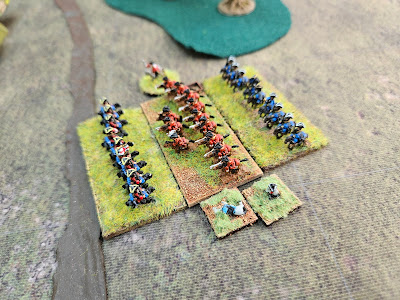
4 English Infantry  with CinC General 2pt. (see 1 on image)

4 British Horse (galloping horse) with General 1pt (see 2 on image)

4 German allies Infantry plus medium gun  with General 1pt (see 3 on image)

French

4 French Infantry  with CinC General 1pt

4 French Infantry with  General 1pt

4 Horse (2 Elite, 2 trained) with General 2pt


Stream Crossing: The English left wing commander stacked his brigades up in 4 lines of battle (this provides a +2 bonus to moral from having multiple rear support) and advanced towards the stream.  The French commander marched his troops down to the bank of the rived.  The English general realised that he would have to successfully order his troops to cross the thick hedges and then wade the stream, therefore he stopped in musket range relying on the extra moral of his multiple ranks plus his superior platoon firing disciple in defeat the French Infantry.

The English cavalry commander lead his troops forward across the hedges and stream.  The first two regiments crossed the stream by rolling two action tests. The 2nd line halted on the English side of the stream.  


Cavalry v's Cavalry: The French horse advanced and two of their right wing infantry wheeled to cover their flank.  The remaining English horse cross the stream (their general having to help then with the activation) and advanced to support the first line of horse, who charge the elite French cavalry. 

The French cavalry as the passive side  were required to test their moral against the charge of the Galloping horse. They failed their test and as cavalry were required to take a moral hit and to fall back a full move backs to their attackers…but as they had formed up in two lines of battle with supporting troops behind them they  instead fall back behind their support and turned to face the English.   (I liked how cavalry loosing a fight always fall back and how historically correct formations help both in the fight be giving a rear support bonus and by providing support to fall back behind.)

The cavalry battle continued  for several turns.  One of the English regiments finding itself without rear support, lost a fight and was forced to retire a full move (3BW 18cm) which took them back across the stream and hedges.


Artillery: The French guns on their right flank bombarded the English infantry attempting to slow them down but without any effect.  Once the English infantry started to exchange musket fire with the French Infantry defending the stream the guns provided a penalty to English moral tests.  On the English right flank their artillery provided a similar penalty to the French troops defending the village. 

Cavalry frontally changing Formed Infantry: One of the English brigades of horse charged a French Infantry Brigade with rear support who made a terrible moral roll and the brigade was lost.  The English then  charged the supporting French line but  the French held and subsequently drove off the English who without any rear support fell back a full move. (Infantry should generally outlast cavalry in a fight but as each turn the passive player had to take moral checks a very poor dice roll can result in the loss of a unit.)

 Infantry vs  Buildings: The English  (German allies) advanced on the village, defended by two brigades with two more to the flank.  After an exchange of musket fire a the Germans attempted a bayonet assault on the village.   This required the French defenders to take a moral test which they passed.  Infantry defending fortifications who succeed in a test can force the attackers to fall back, which they did.  (I like the mechanism of forcing  attackers to fall back from a failed assault.) 


Infantry vs Infantry: One the left flank the English infantry tied to shoot their way across the stream. The Defending French Infantry  needed to roll 6+ to success in their moral test vs the English musketry (needing 8+  but having +1 for rear support and +1 for defending the stream).  Throughout the battle the French infantry defending the steam succeeded in every moral test, although their general had to step in with a re-roll a few times.

The attacking English also succeeded their moral tests ( needing 8+, +2 rear support, +1 superior rate of fire to French, -1 French artillery), although their general had to step in with a re-roll a few times.


Wing & Army Moral:  On the English right flank their German allies destroyed two French Brigades.  This took the French left wing to 50% casualties and they failed their moral and the remaining two brigades fled the battlefield. 

In the centre the English cavalry were also reduce to 50% but succeeded their wing moral however the remaining two brigades of horse were subsequently destroyed n combat. 

The French Cavalry centre attempted to hold off the Germans advancing from the English left flank.  They lost another Brigade and failed their Wing's moral.  This took the French Army to their moral test which they succeeded but the French CinC could see he had 4 brigades of foot vs. 8 English brigades and decided to quit the field.

Conclusion:  An interesting set of rules which ,to me, reflect the feel of the period.  I have also played the sister rules for the Seven Years War "Twilight of the Soldier Kings" which are a little more complex but reflect the period.  The thing I struggle with is the "passive" player testing their moral rather than the "active" player rolling to hit.  There is no reason for this to feel strange other than it's different to any other rules I have played.